History
Initially, the LEAD Programme was established in 1987 at Leiden University in The Netherlands, but in 2020, it was decided to change its status in order to become an independent international platform for ethnoscience research and education, and as such better prepared to contribute to the newly-developing field of ethnoscience disentangled from institutional policies and strategies, and facilitate collaborative IKS-based research and education.
The beginning

In 1987, Dr. D. Mike Warren en Dr. L. Jan Slikkerveer established the LEAD Programme during the Inaugural Lecture Series of the CIKARD-LEAD Global Network on Indigenous Knowledge Systems at CIKARD of Iowa State University in Ames, Iowa, USA. While CIKARD supported the new IK-Centers in South-America and West-Africa, LEAD co-founded KENRIK in Nairobi, Kenya, and INRIK in Bandung, Indonesia. Later, CIRAN joined the Global Network with the support of NUFFIC in The Hague, The Netherlands. Following the Newsletter, the Global IKS&D Network published from 1992-1995 with CIRAN the ‘Indigenous Knowledge and Development Monitor’, encompassing 6.000 members and 35 IK-related Centres from around the globe.
Launching of several IK-Centra
LEAD, under the directorship of Prof. Dr. L.J. Slikkerveer, then took up the support for the Kenyan Resource Centre of Indigenous Knowledge (KENRIK) together with Prof. Dr. R.E. Leakey of the National Museums of Kenya in Nairobi. Soon thereafter, LEAD together with Prof. Dr. K. Adimihardja launched the Indonesian Resource Centre of Indigenous Knowledge (INRIK) at Universitas Padjadjaran. In 1995, LEAD and CIKARD jointly established the Monograph Series on Indigenous Knowledge Systems & Development with Dr. Neil Burton at the Intermediate Technology Publications (ITP) in London, UK. Currently, ITP is known as Practical Action Publications, located in Rugby, UK. Since its establishment, LEAD was involved in many research projects in applied ethno-science, conducted in East Africa, Southeast Asia and the Mediterranean Region, in particular in the field of ethnomedicine & public health, palaeo-ethnobotany, ethno-agriculture and ethno-economy and development.
Indigenous Knowledge
With the appointment of Prof. Dr. L.J. Slikkerveer in 1998 on the Martha Tilaar Chair on Ethnobotanical Knowledge Systems in Developing Countries at the Leiden University Branch of the National Herbarium of The Netherlands, the LEAD Programme got the opportunity to further extend its activities in the multidisciplinary field of ethnoscience, particularly with regard to the study of indigenous knowledge of MAC plants in various settings in Southeast Asia, Sub-Saharan Africa and the Mediterranean Region.

Meanwhile, LEAD became in 1989 the Project Coordinator of the Palaeo-ethnobotanical Research Project on ‘Origins and Development of Indigenous Agricultural Knowledge Systems in East Africa’, executed in Gogo Falls in West Kenya in cooperation with Prof.Dr. R.E. Leakey of the National Museums of Kenya (NMK) in Nairobi, Kenya. The significant research findings include the discovery of the first manifestation of a progenitor of domesticated food plants, used in Sub-Saharan Africa during the Neolithic Era, Elusine indica spp., which later evolved into a major indigenous staple food of sorghum in the research area (1991). The discovery of the first evidence of palaeo-ethnobotanical seeds from pre-domesticated food plants in East Kenya from prehistory encapsulated specimen of carbonised seeds, retrieved from prehistorical hearths at semi-permanent dwelling locations.
The discovery of the first evidence of palaeo-ethnobotanical seeds from pre-domesticated food plants in East Kenya from prehistory encapsulated specimen of carbonised seeds, retrieved from hearths at semi-permanent dwelling locations.
Revolution in the scientific approach to the origins of early agriculture

The pioneering relevance of the palaeo-ethnobotanical research in East Africa for advanced agricultural development in developing countries today attracted the interest of scientists, the media and the general public. The project, which was sponsored by Philips Medical Systems, revolutionized the scientific approach to the origins of early agriculture in Sub-Saharan Africa, until then dominated by the reconstruction of early food production in the ‘Fertile Crescent’ of the region of the Middle East and the Mesoamerican evidence found in the prehistoric settlements in present-day México.
The spectacular discovery of these first specimen of pre-domesticated food plans in Sub-Saharan Africa was celebrated with a small exhibition and an official function with the research team, the sponsors and the National Unesco Commission in The Netherlands in the Knight’ Hall (‘Ridderzaal’), the seat of the Government of The Netherlands in the Binnenhof in The Hague on 31 May 1991.
Recognition of UNESCO
The major discovery of the Palaeo-ethnobotanical Research Project of the the world’s first retrieved carbonised plant seeds from pre-domesticated food plants from the Neolithic Period of time in East Africa, and its implications for today’s food plant cultivation and production rendered the LEAD Programme the official recognition and seal of UNESCO as an important research programme within the United Nations ‘Decade for Culture and Development’ (1991-2001).
The major discovery of the Palaeo-ethnobotanical Research Project of the the world’s first retrieved carbonised plant seeds from pre-domesticated food plants from the Neolithic Period of time in East Africa, and its implications for today’s food plant cultivation and production rendered the LEAD Programme the official recognition and seal of UNESCO as an important research programme within the United Nations ‘Decade for Culture and Development’ (1991-2001). The great honour awarded to LEAD was further substantiated in the subsequent research programmes subsidized by several internarial funding agencies, including the European Union in Brussels.
The true significance of Dubois’ discovery in Java
As in 1893, the famous anthropologist Eugene Dubois announced his world-famous discovery in Solo in Java , Indonesia of the first ‘Missing Link’ between Ape and Man. The publication of Dubois’ discovery of the first fossil remains of an early human ancestor, the upright-walking Ape-Man, to which he attributed the scientific name Pithecanthropus erectus marked the beginning of a new stage in the reconstruction in the history of humankind. However, the true significance of Dubois’ work and vision on the interaction between Man and his Environment throughout time had so far remained outside the limelight of several preceding celebrations – his reorientation towards our place within – and not above – nature. Therefore, the LEAD Programme has taken the initiative to hold the 1893-1993 International Centennial Conference under the title of ‘Human Evolution in its Ecological Context’.

In 1993, LEAD’s Director Prof.Dr. L. Jan Slikkerveer was elected Chairman of the Pithecanthropus Centennial Foundation (PCF), which organised the international celebration of the discovery of one hundred years ago of the first human fossils in Trinil, Java, Indonesia by the Dutch anthropologist Eugene Dubois with an International Conference and an Exhibition ‘Man-Ape Ape-Man’ at the National Museum of Natural History in Leiden. Apart from Dubois’ major contribution to the theory of human evolution, the true significance of his work and vision on the interaction between Man and his Environment throughout time had so far remained outside the limelight of several preceding celebrations – his reorientation towards our place within – and not above – nature. Therefore, the LEAD Programme has taken the initiative to hold the 1893-1993 International Centennial Conference under the title of ‘Human Evolution in its Ecological Context’. The celebrations of the International Conference and Exhibition were officially opened by H.R.H. Prince Bernhard of The Netherlands in the Pieterskerk in Leiden, highlighted by a performance of Indonesian music and dance by the students dance group LISES from Universitas Padjadjaran, and a commemorative speech by Dr. Jane Goodall (UK).
LEAD Public Lecture of 50 Years of Indonesia’s Independence
In 1995, the joint celebration of the 50th Years of Independence of the Republic of Indonesia organised by the LEAD Programme and the Indonesian Ambassador H.E Soedarmanto Kadarisman and Madame in the Great Auditorium of the Academy Building of Leiden University marked the excellent relations between The Netherlands and Indonesia, particularly in science and culture.
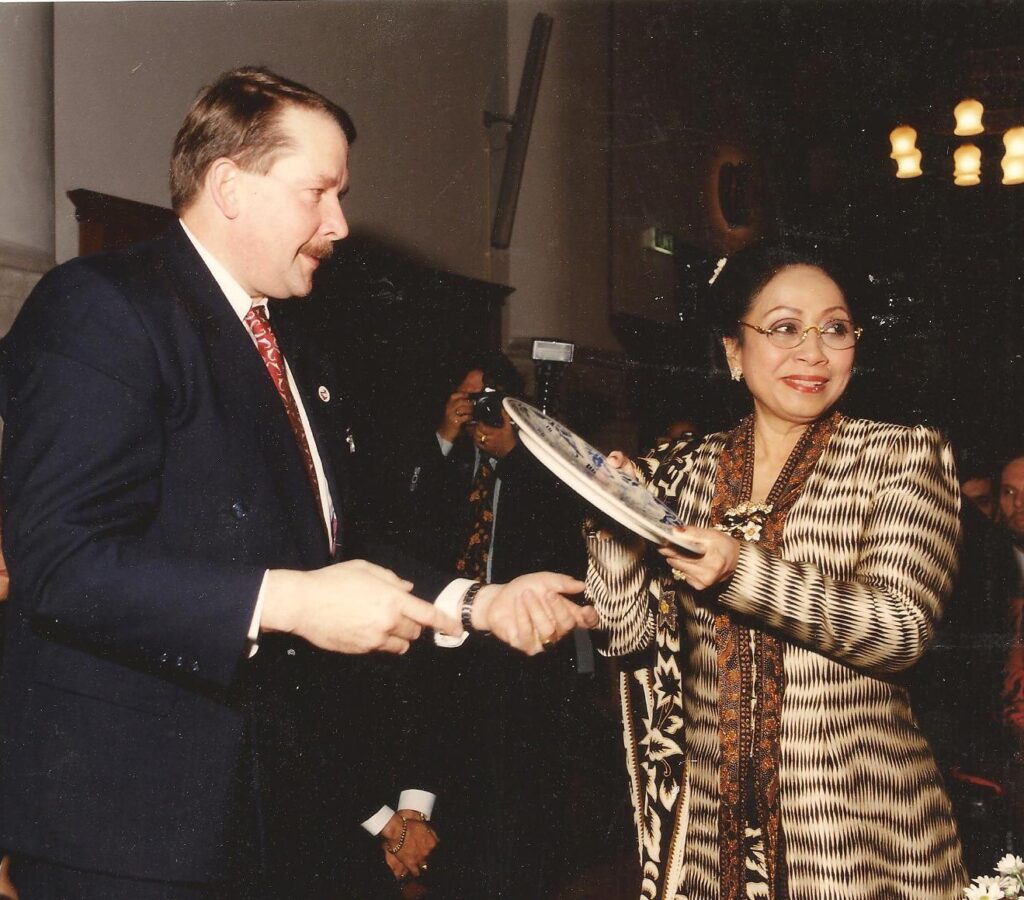
The celebration was accentuated by the Public Lecture by the renown Mrs. Dr. Martha Tilaar from Jakarta on ‘Jamu: Medicinal Plants from Indonesia’ which underscored the great importance of traditional herbal medicine in health care development in Indonesia and elsewhere around the globe. Her historic lecture in the heart of scientific thinking about the integration of traditional and modern medicine provoked much discussion on the future of health and healing on a global scale.
Her historic lecture in the heart of scientific thinking about the integration of traditional and modern medicine provoked much discussion on the future of health and healing on a global scale. The remarkable function was enlightened by the festive music and dance performance by a group of artists from Indonesia, introduced by the famous actress Mrs. Rima Melati.
Special issue of a commemorative Indonesian postage stamp
As a follow-up, further cooperation developed between the Martha Tilaar Group in Jakarta and the LEAD Programme of Leiden University in the field of ethnomedicine and sustainable community development, particularly on the role of medicinal MAC plants (jamu) in integrated public health management and development in Indonesia.
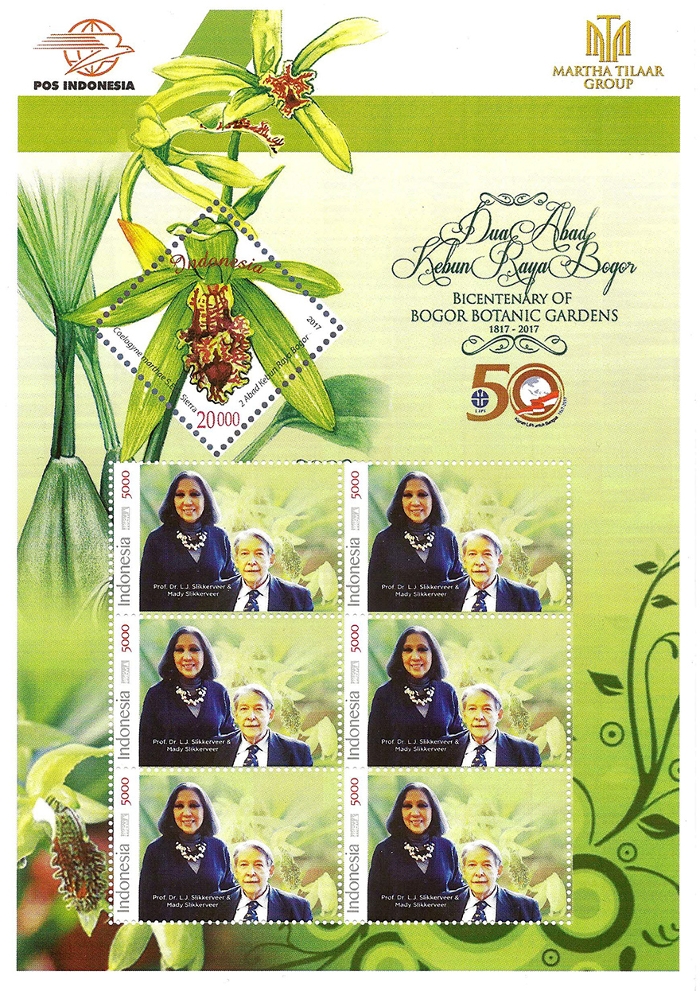
Within the context of this successful scientific collaboration, which pertained to several projects, courses and international exhibitions, a special postage stamp was issued by the Botanical Garden of Bogor (Kebun Raya Bogor) in 2017 under the auspices of the Academy of Science of the Republic of Indonesia (LIPI) to pay tribute to the work of Prof. Dr L. Jan Slikkerveer and his wife for their work on the bio-cultural conservation of MAC plants in Indonesia.
A similar postage stamp was also granted to two colleagues Prof.Dr. P. Baas, Director and Dr. S. Sierra, Botanist of the former National Herbarium of The Netherlands for their contribution to the naming of a rare orchid species discovered in Kalimantan in Indonesia to Dr. Martha Tilaar, Coelogyne marthae S.E.C. Sierra, for her support for the Extraordinary Professorial Chair Ethnobotanical Knowledge sSstems regarding Medicinal Plants in Developing Countries at Leiden University.
Meanwhile, after its establishment in 1987 as one of the three leading centers of the Global Network on IKS&D, the LEAD Programme has been recognised as a frontier research programme (‘Speerpunt onderzoek’ ) at Leiden University, and initiated many international research and education programmes, projects, courses and publications in applied ethnoscience and its subfields.
Research history
In December 1988, Prof. Dr. Richard E. Leakey, Director of the National Museums of Kenya in Nairobi and Prof. Dr. L. Jan Slikkerveer, Director of the LEAD Programme of Leiden University signed a Letter of Intent on joint scientific research and training in the field of ethnoscience. This event marked the beginning of a long-term fruitful collaboration programme up until today, pertaining to several major research projects and programmes in East Africa (Kenya and Tanzania) in South-East Asia (Indonesia and Singapore) and the Mediterranean Region (Crete, Greece).
Linking up with a similar Letter of Intent, undersigned in 1987 by Prof.Dr. Kusnaka Adimihardja, Chair of the Department of Anthropolgy of Unversitas Padjadjaran in Bandung, Indonesia and Prof. Dr. L. Jan Slikkerveer, Director of the LEAD Programme, enabling the expansion of international cooperation with counterparts in the newly-developing field of applied ethnoscience. In addition, joint PHD studies have also been realised in conjunction with several joint Symposia and Workshops organised in the target regions of the LEAD Programme.
The activities of the LEAD Programme further developed its focus in research on the role of Indigenous Knowledge Systems in sustainable community development in sectors such as health care, agriculture, environment, bio-cultural management and conservation, and soon was extended in the interest in the knowledge, experience and practice of the often poor, marginalized indigenous peoples in the rural areas of developing countries. A significant experience of some case studies in Ghana, Tanzania, Kenya and Indonesia underscored the crucial role which indigenous institutions can play in a combined community development approach at the community level with financial, educational, health, communication and socio-cultural services, well attuned to local traditions and structures.