Ubar Kampung: plants used for the treatment of diabetes mellitus in the Tatar Sunda Region of West Java, Indonesia
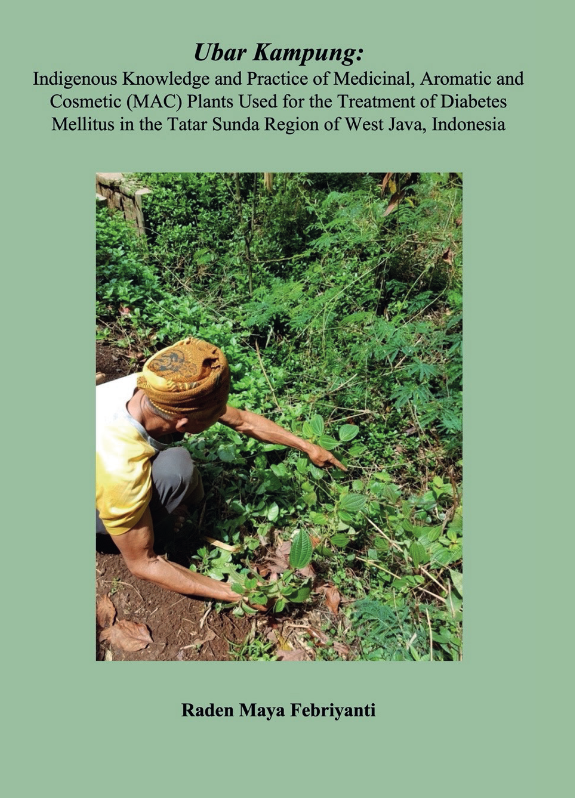
Maya Febriyanti, M. Farm, Apt, conducted PhD research on Ubar Kampung for Diabetes Mellitus in the Tatar Sunda Region of West-Java: A Complementary Study of Indigenous Knowledge, Use and Development of Medicinal, Aromatic and Cosmetic Plants in Indonesia under the auspices of the LEAD Programme.
The Sundanese people, the largest ethnic group in West Java, have been using traditional medicine for a long time. Known as ubar kampung, Sundanese indigenous knowledge, beliefs and practices of traditional medicine are based on local people’s knowledge and use of Medicinal, Aromatic, and Cosmetic (MAC) plants. MAC plants have continuously provided the Sundanese community with practical and readily available traditional medicine. Despite the remarkable contribution of indigenous medical knowledge in society, the practical utilisation of indigenous resources at the community level have hardly ever been the focus of research. At the same time, the practice of Sundanese traditional medicine in West Java is also at risk of being lost. To address the lack of studies on indigenous knowledge and its role in patterns of health care utilisation, this study aims to document, describe, and analyse knowledge of, beliefs in, and practices with MAC plants among the Sundanese community members in the environment where biomedicine and traditional medicine are co-existing. While most studies on health care utilisation are currently limited by the use of one medical system – generally speaking, the modern medical system – the present study has a primary focus on utilisation across medical systems. The broad objective of this study is to explore the utilisation of the plural medical system with particular attention to the role of knowledge and practice of ubar kampung by the Sundanese community for the treatment of diabetes mellitus.This study employs the ‘Leiden Ethnosystems’ Approach’ methodology to document and analyse Indigenous Knowledge Systems at the community level which consists of three basic concepts including the Participant’s View (PV), the Field of Ethnological Study (FES) and the Historical Dimension (HD). In the context of health care utilisation behaviour, this approach can also be extended to the concept of medical pluralism in which the traditional, transitional, and modern medical systems co-exist within the community. Comparison of the medical systems in the community provides a better understanding of the determinants of health care utilisation behaviour.
She was granted a PhD Degree at Leiden University on 16 november 2021 by his Promotor: Prof. Dr. L.J. Slikkerveer. The PhD Committee included Prof.dr. G.P. van Wezel, Prof.dr. E.F. Smets, Prof.dr. B. Gravendeel, Prof.dr. K. Lestari (Universitas Padjadjaran, Bandung, Indonesië) and Dr. K. Saefullah (Universitas Padjadjaran, Bandung, Indonesië)
Maya Febriyanti, M.Farm, Apt, Ubar Kampung for Diabetes Mellitus in the Tatar Sunda Region of West-Java: A Complementary Study of Indigenous Knowledge, Use and Development of Medicinal, Aromatic and Cosmetic Plants in Indonesia. PhD Dissertation Leiden University, LEAD Studies No. 13, Leiden University, xvi + 223 pp. ill., 2021.